Open Wide and Hold On: The Brutal Reality of the American Dentist's Chair Before Novocaine
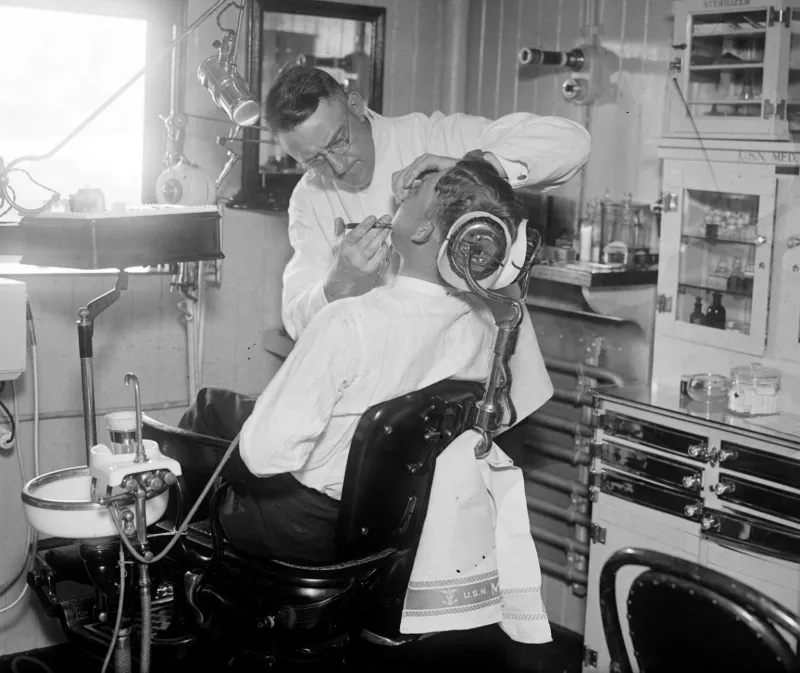
Photo: vintage 1920s dentist office dental chair patient, via clickamericana.com
Imagine sitting down in a chair, fully conscious, while someone grips a pair of steel forceps and begins pulling one of your teeth out by the root. No injection. No numbness. Just the sound of your own breathing and the very real understanding that this is going to hurt — badly.
That wasn't a horror story. For millions of Americans in the late 1800s and early 1900s, it was just a Tuesday.
We talk a lot about dreading the dentist. But the modern version of that dread — the low-level anxiety about a cleaning or a filling — is almost laughably mild compared to what dental care once actually involved. The transformation of American dentistry over the past century is one of the most dramatic, and least appreciated, quality-of-life revolutions in modern history.
The Tooth Puller Era
For much of the 19th century, dentistry in America was barely a profession at all. "Tooth drawers" — often barbers, blacksmiths, or traveling salesmen — would yank problem teeth using little more than brute force and a sturdy pair of pliers. There was no formal training required. No licensing board. No sterile environment. Just someone willing to do an unpleasant job for a small fee.
Pain was simply part of the transaction. Patients gripped the armrests, or were held down by assistants, and endured. Alcohol was sometimes offered beforehand — not as a medical protocol, but as a mercy. A stiff drink before an extraction was considered entirely reasonable preparation.
Even as dentistry formalized in the mid-to-late 1800s — the first American dental school opened in Baltimore in 1840 — the tools were still crude and the pain was still real. Drills existed, but they were slow, hand-cranked instruments that ground through enamel at an agonizing pace. A cavity filling could take the better part of an hour, with the patient fully alert for every second of it.
The Arrival of Relief
Cocaine was actually the first local anesthetic used in dental procedures, introduced in the 1880s. It worked, but it came with obvious problems. The real turning point came in 1905, when German chemist Alfred Einhorn synthesized procaine — marketed as Novocaine. By the 1910s and 1920s, it was making its way into American dental offices, and it changed everything.
For the first time, a dentist could numb a specific area of the mouth before working on it. The patient stayed conscious but felt nothing in the relevant spot. It sounds basic. At the time, it was genuinely revolutionary.
But adoption was slow and uneven. Rural America lagged behind. Dentists trained in the old ways sometimes resisted the change. And for a generation of patients who had grown up expecting pain, the idea that a dental visit might not hurt was almost impossible to believe. The cultural dread of the dentist — already deeply embedded in American life — persisted long after the actual reason for it had been removed.
What Modern Dentistry Actually Looks Like
Today, the contrast is almost surreal. A routine filling at a modern American dental office involves a topical numbing gel applied before the injection, so patients often barely feel the needle itself. The anesthetics used today are faster-acting, longer-lasting, and more precisely targeted than anything available even fifty years ago.
Digital X-rays deliver a fraction of the radiation of older film-based systems. Laser dentistry can treat gum disease and remove decay without a drill at all. CAD/CAM technology allows dentists to design and mill a ceramic crown in a single visit — a process that once required weeks of waiting and multiple appointments. Sedation dentistry, ranging from nitrous oxide to oral sedatives to full IV sedation, means that patients with severe anxiety can be essentially asleep through procedures that would have been nightmarish experiences for their great-grandparents.
Even the chair is different. Modern dental chairs are ergonomically designed, adjustable, and built around patient comfort. The old-fashioned upright wooden chair — essentially a torture device with armrests — is a museum piece.
The Fear That Outlasted the Pain
Here's the strange part. Despite all of this progress, dental anxiety remains remarkably common in America. Studies suggest that somewhere between 36 and 50 percent of Americans experience some level of fear about dental visits, and roughly 20 percent avoid the dentist entirely because of it.
Some of that is the residual echo of genuine historical trauma, passed down through generations of families who associated dentistry with suffering. Some of it is the sounds — the drill, the suction — which trigger anxiety even when they're no longer accompanied by pain. And some of it is simply the vulnerability of lying back with your mouth open while someone works inside it.
But the gap between the fear and the reality has never been wider. A routine cleaning today involves no pain at all for most patients. Even significant procedures — root canals, extractions, implant placements — are performed under local anesthesia so effective that patients often report being surprised by how little they felt.
A Revolution We Barely Notice
It's worth pausing on how completely this transformation happened, and how little credit we give it. The Americans who sat in those early dental chairs weren't weak or unusual. They were ordinary people facing an ordinary medical reality of their era. Pain was the price of treatment, and most of them paid it.
The fact that you can walk into a dentist's office today, get a cavity filled, and drive yourself home to work an afternoon shift — without any significant discomfort — is the result of over a century of accumulated scientific progress. Chemistry, engineering, materials science, and medical training all converged to make something genuinely terrible into something merely inconvenient.
We still dread the dentist. We just don't have a very good reason to anymore.