She Packed a Goodbye Letter in Her Hospital Bag: The Transformation of American Childbirth
Sometime around 1910, a pregnant woman in rural Ohio sat down at her kitchen table and wrote a letter to her husband. She told him where the savings were kept, what to do with the farm if things went wrong, and how she wanted the children raised. Then she folded the letter, tucked it somewhere safe, and waited for labor to begin.
She wasn't being dramatic. She was being practical.
Dying in childbirth wasn't a remote possibility in early 20th-century America. It was a realistic outcome that women, their families, and their doctors quietly factored into every pregnancy. The numbers tell a story that's almost impossible to sit with: in 1900, roughly 900 women died for every 100,000 live births in this country. To put that in perspective, a woman having four children — completely normal at the time — faced cumulative odds of death that would make a modern actuarial table blush.
Today, that number sits around 23 per 100,000. And while that figure still carries its own troubling inequalities, the overall transformation is one of the most dramatic shifts in American life that almost nobody talks about.
What Made Childbirth So Deadly
The killers were specific, and they were relentless.
Childbed fever — puerperal sepsis, in clinical terms — was the big one. Bacteria introduced during delivery would spread through a woman's bloodstream with terrifying speed, and before antibiotics, there was essentially nothing doctors could do once infection took hold. A woman could be healthy on Monday and dead by Friday.
Hemorrhage was the other great executioner. When bleeding wouldn't stop after delivery, physicians had almost no tools to intervene. Blood transfusions as we know them didn't exist in reliable form until the 1910s and 1920s, and even then, they weren't widely available outside major cities. If a woman bled out on a farm in Mississippi or a tenement in Chicago, she simply bled out.
Eclampsia — dangerous spikes in blood pressure during pregnancy — rounded out the trio of terrors. Without the monitoring tools to detect it early or the medications to manage it, it frequently progressed to seizures and death.
And then there was the setting itself. Most American births happened at home, attended by whoever was available — a midwife if you were lucky, a neighbor if you weren't. Sterile technique was understood in theory long before it was practiced consistently. Doctors sometimes moved directly from examining a sick patient to delivering a baby without washing their hands, carrying infection with them like an invisible toll.
The Slow, Unglamorous Revolution
The turnaround didn't happen overnight, and it didn't come from a single miracle breakthrough. It was a grinding accumulation of improvements, each one chipping away at the odds.
Hospital births became more common through the 1920s and 1930s, bringing with them sterile environments and trained staff. Sulfonamide drugs arrived in the late 1930s and gave doctors their first real weapon against bacterial infection — maternal mortality dropped sharply almost immediately. Penicillin followed in the 1940s and finished what sulfonamides started. Childbed fever went from a near-certain death sentence to a treatable condition within the span of about fifteen years.
Blood banking — the ability to store and type donated blood — transformed hemorrhage from a probable killer into a manageable emergency. Prenatal care, which barely existed as a structured practice before the 1920s, became standard, allowing doctors to catch warning signs of eclampsia before they became catastrophic.
By the 1950s, giving birth in America was still riskier than it is today, but it had already become a fundamentally different experience from what women had faced just two generations earlier.
What Modern Mothers Take for Granted
Consider what a routine 2024 pregnancy actually involves: a dozen or more prenatal appointments, ultrasounds that can detect complications months before birth, blood pressure monitoring at every visit, genetic screening, gestational diabetes testing, and a delivery room stocked with surgical capabilities, anesthesia, and blood products on standby.
An obstetrician today has real-time information about a mother's condition that physicians in 1920 could not have imagined. If a C-section becomes necessary, it happens in minutes. If bleeding occurs, transfusions are immediate. If infection develops, antibiotics are administered within hours.
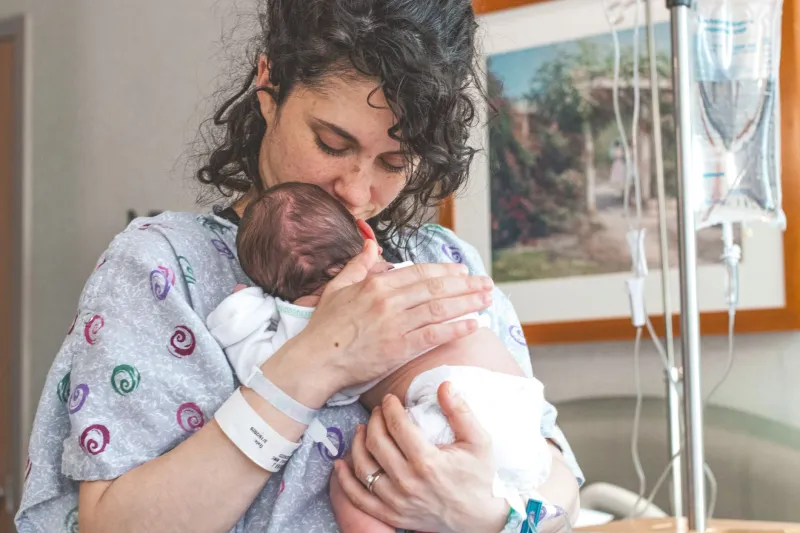
None of this feels miraculous to the woman lying in the hospital bed. It just feels like Tuesday. That's exactly the point — the revolution was so complete that its results now read as ordinary.
The Part We Still Get Wrong
Here's where the story gets complicated. America's maternal mortality rate, while dramatically lower than a century ago, remains significantly higher than most other wealthy nations. Black women in the United States die in childbirth at roughly three times the rate of white women — a disparity driven by a combination of systemic healthcare inequities, chronic stress, and documented patterns of undertreated pain and dismissed symptoms.
The history of American maternal mortality isn't just a triumph story. It's also a reminder that progress distributed unevenly isn't fully realized progress.
A Different Kind of Courage
Women who had children in 1900 weren't unaware of the risks. They knew. They wrote the letters, said the prayers, and showed up anyway — because that's what life required of them.
The goodbye letter in the hospital bag wasn't a symbol of weakness. It was a rational response to a genuinely dangerous world.
The fact that modern mothers don't need to write those letters isn't something we stumbled into by accident. It was built, piece by piece, by researchers, physicians, public health advocates, and the quiet pressure of a society that gradually decided women's lives were worth protecting.
That's worth knowing. And it's worth remembering every time a birth announcement shows up in your feed and everyone involved comes home fine.