The Train Was First Class. The Plane Was a Gamble. Then Everything Flipped.
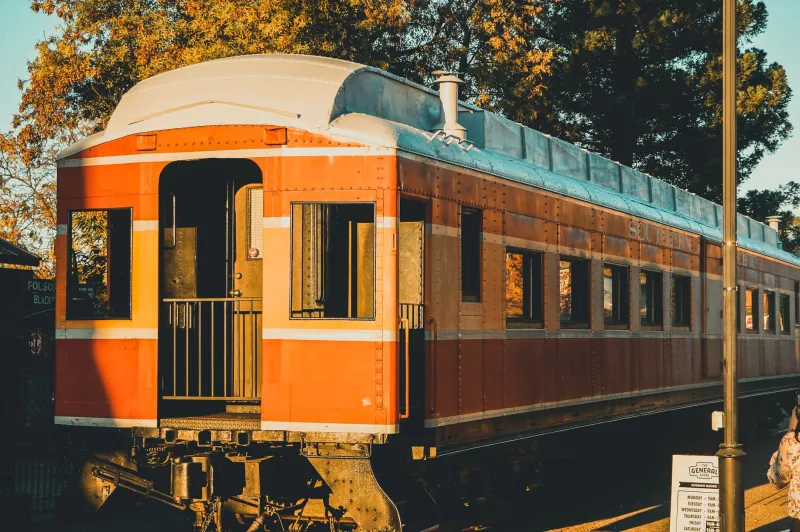
Ask most Americans today what they picture when they imagine stylish, effortless travel, and you'll hear a fairly predictable list: a direct flight, maybe a business-class seat, possibly a window view above the clouds. What you almost certainly won't hear is the train. But go back to 1948 — ask the same question to a middle-class family in Cincinnati or a businesswoman in Philadelphia — and the answer would have been completely different. The train wasn't just a way to get somewhere. It was the whole point.
The airplane, by contrast, was something you did if you were either very rich, very impatient, or possibly not thinking straight.
All Aboard the American Dream
At its postwar peak, American passenger rail was something genuinely worth celebrating. The great named trains — the California Zephyr, the 20th Century Limited, the Super Chief — weren't just transportation. They were rolling hotels, complete with white-tablecloth dining cars, private sleeping compartments, observation lounges with curved glass ceilings, and porters who knew your name by the second day. Traveling from Chicago to Los Angeles on the Super Chief meant two nights of some of the finest scenery in the country drifting past your window while you ate a proper dinner and slept in an actual bed.
 Photo: Super Chief, via www.american-rails.com
 Photo: California Zephyr, via cdn.shopify.com
For most American families, this was aspirational. Rail travel was what progress looked like. The railroads had, after all, stitched the continent together. They'd carried soldiers, mail, and presidents. The idea that anything could replace them seemed not just unlikely but almost unpatriotic.
And airplanes? In 1950, fewer than 10 percent of Americans had ever boarded one. The machines were loud, unpressurized at lower altitudes, prone to turbulence that sent meals into the overhead racks, and statistically — at least in public perception — worryingly dangerous. Crashes were reported with grim regularity. Ordinary people read those stories and made a quiet personal policy: not for me.
The Jet Changes Everything
The shift didn't happen overnight, but it happened faster than anyone expected. The introduction of commercial jet service in the late 1950s was the first domino. Jets were smoother, faster, and dramatically more reliable than the propeller aircraft that had shaped aviation's nervous reputation. When Pan Am launched transatlantic jet service in 1958, and domestic carriers followed with coast-to-coast routes shortly after, the travel time equation was suddenly rewritten.
A train from New York to Los Angeles took roughly 65 hours. A jet took five. For the first time, speed wasn't just a luxury — it was a genuine argument.
At the same time, something was going wrong with the rails. The federal government, flush with postwar ambition, poured billions into the Interstate Highway System beginning in 1956. Families bought cars. Suburbs expanded. The automobile became the default mode of American life for shorter distances, and the airlines mopped up the longer ones. The railroads, caught between two competitors and saddled with aging infrastructure, began a slow financial unraveling.
When Prestige Followed the Jet Set
Culture followed money, as it tends to do. By the early 1960s, flying had acquired a glamour of its own — and a very different kind from the train's unhurried elegance. Jet-setting was fast, modern, forward-looking. Flight attendants were cultural figures. Airport lounges had cocktail bars. Celebrities flew. Presidents flew. The train, once the symbol of American sophistication, began to feel like it belonged to another era — which, increasingly, it did.
The dining cars got cut first, then the sleeper routes, then the frequency. By the time Amtrak was created in 1971 — a government rescue operation for a dying industry — passenger rail had already lost the cultural argument. Amtrak absorbed the routes but inherited the reputation: slow, unreliable, and vaguely sad.
Meanwhile, airline deregulation in 1978 cracked open the market and sent fares tumbling. Flying stopped being a luxury and became, over the following decades, closer to a bus ticket with wings — less glamorous, certainly, but available to almost everyone.
The Irony Nobody Planned
Here's the part that would have baffled a 1950s traveler: today, the train is experiencing a quiet cultural rehabilitation precisely because it feels like a slower, more human alternative to the modern airport experience. The TSA line. The middle seat. The $14 airport sandwich. The delay notification that arrives 20 minutes after you were supposed to depart.
Amtrak ridership hit record highs in 2023. Rail corridors in the Northeast and California carry millions of passengers who have decided that arriving at the station 20 minutes before departure and sitting in a real seat with legroom is worth the extra hour of travel time. High-speed rail projects are being debated with a seriousness not seen in decades.
The glamour never fully came back. But the logic did.
A Reversal Worth Remembering
What the great transportation flip really illustrates is how completely a generation's assumptions about progress can turn inside out. The railroads weren't replaced because they were bad. They were replaced because something faster came along, and then a culture built itself around that faster thing, and then the faster thing became so stripped of comfort that people started looking back.
Your great-grandparents would find a modern airport baffling and a little depressing. They'd recognize an Amtrak train immediately — and probably wonder why everyone stopped riding them in the first place.