The Hidden Gatekeepers Who Used to Stand Between You and Your Own Business
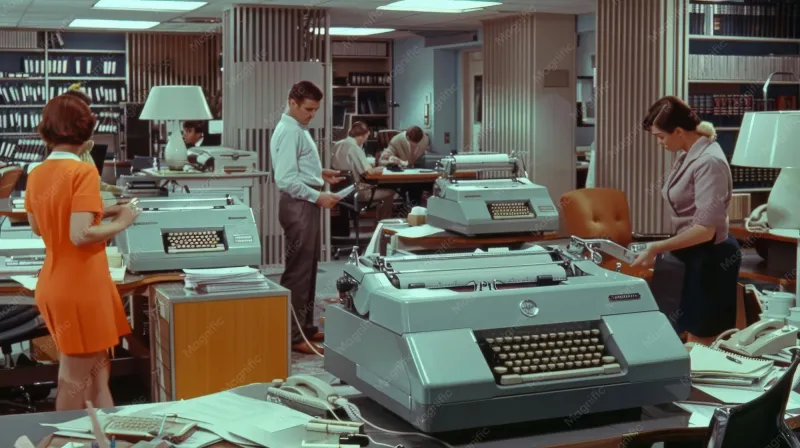
Photo: 1960s small business owner paperwork government office vintage America, via img.freepik.com
Somewhere in America right now, someone is forming an LLC on their phone during a lunch break. They'll spend about $50 in state filing fees, answer a dozen questions on a website, and receive confirmation by email before dinner. By next week, they'll have a business bank account, a payment processor, and a website reaching potential customers in forty countries.
Total time invested: maybe four hours.
Half a century ago, that same ambition would have launched a very different journey — one involving attorneys, government clerks, weeks of waiting, and a set of informal gatekeepers who had enormous power over who got to participate in American economic life and who didn't.
The story of how starting a business went from an ordeal to an afternoon is one of the most consequential — and least celebrated — changes in modern American life.
The Paperwork Labyrinth of Mid-Century America
Let's say it's 1962 and you want to open a small retail shop in a mid-sized American city. You have savings, a product, and a plan. Here's roughly what comes next.
First, you need to understand what kind of legal entity you're forming. The LLC — today the default choice for millions of small businesses — didn't exist in the United States until Wyoming created it in 1977. Before that, your options were a sole proprietorship (which offered no personal liability protection), a partnership (same problem), or a corporation (which required a lawyer, formal articles of incorporation, and ongoing legal compliance that most small operators couldn't manage or afford).
So you hire a lawyer. That's not optional — the paperwork is genuinely complex, and one error can invalidate the whole thing. Legal fees for basic business formation in the early 1960s, adjusted for inflation, could run $1,500 to $3,000 or more.
Then come the in-person visits. Business licenses from city hall. A separate county permit, possibly. A state sales tax registration that requires a physical form submitted by mail or in person. Zoning approval. Health permits if you're handling food. Each office has its own hours, its own forms, and its own queue. Each clerk has discretion over whether your paperwork is complete.
If you want a business bank account — and you need one — you'll sit down with a banker who will evaluate not just your financial position but your personal reputation in the community. Banking relationships in mid-century America were deeply local and deeply personal, which is a polite way of saying they were also deeply susceptible to bias. Women, Black Americans, and immigrants faced institutional resistance that went well beyond paperwork.
The whole process, optimistically, might take two to three months. Realistically, longer.
The Invisible Toll of Friction
Here's what's easy to miss about that system: it wasn't designed to be exclusionary. It mostly just was, as a side effect of complexity.
When starting a business requires a lawyer, you've immediately limited the pool of potential entrepreneurs to people who can afford one. When it requires multiple in-person visits during business hours, you've excluded people who can't take time off work. When it requires navigating dense bureaucratic language, you've disadvantaged people whose first language isn't English or who didn't finish high school.
Entrepreneurship in mid-century America wasn't impossible for ordinary people — millions of small businesses opened and thrived. But the friction of the process acted as a filter, and the people who got filtered out weren't usually the ones who lacked good ideas or work ethic. They were the ones who lacked time, money, and connections.
A good idea sitting in the head of a 24-year-old Black woman in Birmingham in 1965 faced obstacles that had nothing to do with the quality of the idea.
How the Wall Came Down
The dismantling happened gradually, through a combination of legal innovation, technology, and deliberate regulatory reform.
The LLC structure, spreading state by state through the 1980s and 1990s, gave small business owners for the first time a legal form that was both protective and relatively simple. You no longer needed corporate formalities to get basic liability protection.
The internet did the rest. State filing systems moved online through the 2000s and 2010s. Forms that once required a trip to a government office became fillable PDFs, then web forms, then streamlined portals. The clerk with discretionary power over your paperwork was replaced by a system that either accepted your submission or flagged a specific error.
Payment processing, once requiring a merchant account negotiated with a bank, became available to anyone with a Stripe account in minutes. Business banking went digital, with accounts openable online without a relationship manager or a firm handshake. Legal templates for operating agreements, contracts, and business structures became available for free or near-free through services that would have seemed like magic to a 1962 entrepreneur.
What $50 and an Afternoon Now Buys You
The numbers are genuinely striking. Forming an LLC in most US states today costs between $50 and $200 in filing fees. Services like Shopify can have an online storefront operational in a day. A seller on Etsy or Amazon can reach millions of customers without a physical location, a sales team, or a distribution network.
The result has been a genuine democratization of entrepreneurship. The share of new businesses started by women has risen steadily for decades. Immigrant entrepreneurship — always a powerful force in American economic life — has accelerated. Young people are launching businesses before they finish college, and the barriers that would once have stopped them cold are largely gone.
None of this means starting a business is easy. Building something sustainable still requires all the things it always required: good judgment, hard work, adequate capital, and a fair amount of luck. The failure rate for new businesses hasn't magically improved just because registration got simpler.
But the gatekeepers — the lawyers you had to hire, the clerks you had to charm, the bankers who had to approve of you personally — are mostly gone. The door to American entrepreneurship is still narrow in plenty of ways. It's just a lot wider than it used to be.
Your lunch break might be enough to walk through it.