The Milkman Already Solved This Problem a Hundred Years Ago
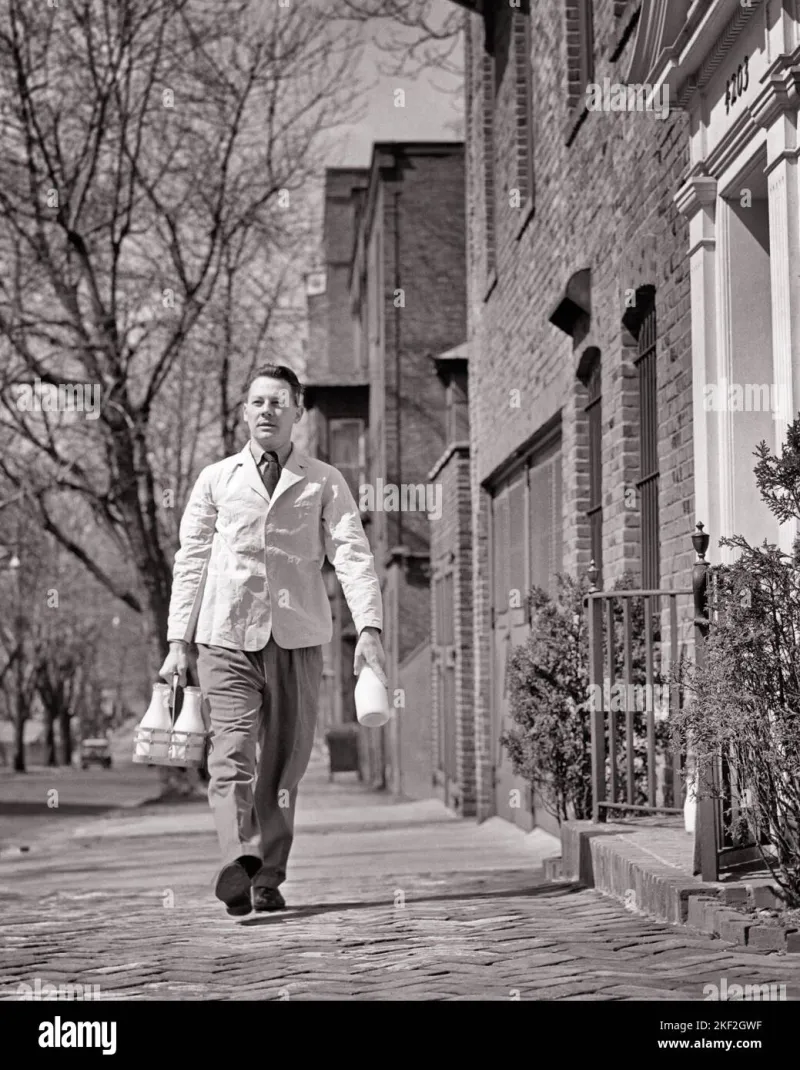
Photo: vintage 1940s milkman delivering bottles to suburban front door, via c8.alamy.com
Somewhere around 2020, as millions of Americans discovered the convenience of having groceries appear at their front door without requiring a trip to the store, the delivery app industry congratulated itself on disrupting an ancient industry. Venture capital poured in. Logistics startups multiplied. Tech journalists wrote breathlessly about the revolution in how Americans feed themselves.
The milkman, had he still existed, might have allowed himself a quiet smile.
Home grocery delivery isn't a 21st-century innovation. It's a 21st-century restoration. For the first half of the 20th century, having essential food items brought directly to your door wasn't a premium service for the time-poor professional class — it was simply how American households operated. The revolution, when it came, was the one that took delivery away. The supermarket didn't just change where Americans shopped. It changed what Americans believed shopping was supposed to look like.
The Morning Routine That Ran Like Clockwork
In a typical American town in 1920, the day began with deliveries. The milkman came before dawn, leaving glass bottles on the doorstep and collecting the empties from the day before. In warmer months, the iceman followed — a physically demanding job that involved hauling enormous blocks of ice up porch steps to keep iceboxes cold. The bread man came. In many neighborhoods, the grocer's delivery boy would appear later in the day with an order that had been called in by telephone or handed to him on a written slip earlier that morning.
This wasn't a luxury system. It was infrastructure. Most American households, particularly in cities, didn't own cars. The idea of loading a family's weekly groceries into a vehicle and driving them home wasn't possible for most people — there was no vehicle to load them into. Delivery wasn't a convenience add-on; it was the default mechanism through which households were provisioned.
The relationship between a family and its regular delivery people was also genuinely personal in a way that modern commerce rarely is. The milkman knew which houses needed an extra quart on Sundays. The grocer extended credit to families he'd known for years, running tabs that were settled weekly or monthly. This wasn't just commerce — it was a web of community relationships built around the daily business of feeding people.
The Supermarket Rewrote the Rules
The chain supermarket began its serious expansion in the 1930s, offering something that the old delivery system couldn't match: dramatically lower prices through volume purchasing and self-service efficiency. When you eliminated the delivery boy and the credit system and the personalized service, you could sell food cheaper. And Americans, particularly through the Depression years, needed cheaper.
After World War II, the combination of rising car ownership, suburban expansion, and the baby boom created perfect conditions for the supermarket to complete its takeover. The new suburbs were built around the car, and the car made the weekly grocery run not just possible but pleasant — a symbol of postwar prosperity and modern convenience. The housewife loading a station wagon with brown paper bags was an image of American success, not an inconvenience to be solved.
By 1960, the old delivery economy had largely collapsed. Milk delivery hung on longer than most — glass-bottle doorstep delivery persisted in some areas into the 1970s and beyond — but the grocer's delivery boy, the bread route, and the daily provisioning culture they represented were gone. Shopping had been redefined as something you did yourself, in person, on a schedule that revolved around the store's hours rather than your own.
And for decades, nobody questioned it. The supermarket was progress. End of story.
The Wheel Turns Again
The first wave of internet-era grocery delivery arrived in the late 1990s and failed spectacularly. Webvan, the most famous casualty, burned through over a billion dollars trying to build a home delivery grocery network before going bankrupt in 2001. The timing was wrong, the economics were brutal, and Americans weren't yet ready to trust an algorithm with their produce selection.
Two decades later, the infrastructure caught up with the idea. Smartphones meant that orders could be placed, tracked, and adjusted in real time. Gig economy labor provided the delivery workforce. And a global pandemic removed whatever residual reluctance remained among Americans who had never seriously considered ordering groceries online.
Instacart, founded in 2012, went from a niche service to an essential utility almost overnight in 2020. Amazon Fresh, Walmart's delivery service, and a dozen smaller competitors rushed to meet demand that suddenly existed at a scale nobody had anticipated. By 2021, online grocery sales in the United States had more than doubled compared to pre-pandemic levels.
 Photo: Amazon Fresh, via m.media-amazon.com
The language used to describe all of this — disruption, innovation, the future of retail — obscured a simpler truth. Americans had decided, after sixty years of doing their own shopping, that they'd actually prefer someone else to bring the food to them. The milkman had been right all along.
What the Full Circle Actually Means
There's a version of this story that's purely comic — the tech industry spending billions to rediscover something that the iceman already knew. But the more interesting question is what the round trip reveals about how we define progress.
The supermarket era wasn't a mistake. It genuinely democratized access to a wider variety of food at lower prices, and the social changes it reflected — car ownership, suburban life, women entering the workforce and needing efficient shopping options — were real. The delivery economy of 1920 was also not purely idyllic; it rested on low-wage labor, rigid social hierarchies, and a domestic model that confined women to the home.
What the full circle suggests is that convenience is less a direction than a pendulum. Each generation inherits a set of systems, decides they're inefficient, builds something new, and eventually discovers that the old system was solving a problem that didn't go away. The grocery delivery revolution of the 2020s is new in its technology and its scale. In its basic logic — food comes to you, you don't go to the food — it's as old as the glass bottles on the doorstep.
Somewhere, the milkman is not surprised.