Smoke Breaks, Suits, and No Sick Days: What Going to Work Looked Like in 1960
Smoke Breaks, Suits, and No Sick Days: What Going to Work Looked Like in 1960
Imagine showing up to your office on a Monday morning, lighting a cigarette at your desk before your coat is even off, glancing around a room where every face looks exactly like yours, and accepting without question that if you get sick tomorrow, you won't get paid. No HR department to call. No ergonomic chair policy. No laptop to take home. Just a desk, an ashtray, and the understanding that this is simply how work works.
That was a normal Tuesday in 1960 for millions of American workers. And while plenty has gotten worse about modern work life — the always-on culture, wage stagnation, the gig economy — the baseline conditions of mid-century employment were genuinely rougher in ways that are easy to forget when you've never experienced them.
The Office Was a Smoke-Filled Room. Literally.
Let's start with the most visceral difference: the air quality.
In 1960, approximately 42 percent of American adults smoked — and they smoked everywhere. At their desks. In meetings. During job interviews. On airplanes. In hospitals. The idea that a workplace might be smoke-free was not just unusual; it was essentially unthinkable. Ashtrays were standard office equipment, as routine as staplers.
The first workplace smoking restrictions didn't begin appearing in any meaningful way until the 1970s, and comprehensive bans didn't take hold until the 1990s and beyond. For three full decades after 1960, a significant portion of American workers spent their entire careers inhaling secondhand smoke as a condition of employment — with zero legal recourse and zero expectation that anything would change.
Today, smoking is banned in workplaces across all 50 states (under varying state and local laws), and the idea of lighting up at a desk would be so bizarre as to be almost comedic. That shift alone represents a profound change in what workers can expect from their physical environment.
The Dress Code Was Non-Negotiable
In 1960, office dress was not a matter of personal expression — it was a uniform, enforced by social expectation and sometimes explicitly by policy. Men in white-collar jobs wore suits and ties, full stop. Dress shirts were pressed. Shoes were shined. Showing up to an office job in anything resembling casual attire was not a fashion choice; it was a career risk.
For blue-collar workers, the specifics varied, but the formality of the era extended even into factory and trade environments in ways that feel foreign today. The relaxation of workplace dress codes happened gradually through the 1970s and 1980s, accelerated with the tech industry's embrace of casual dress in the 1990s, and has continued through the pandemic era's normalization of working in whatever you happen to be wearing.
The rise of "Casual Friday" in the 1990s — now a slightly dated concept itself — was considered a radical workplace perk when it was introduced. The fact that an entire cultural moment was built around being allowed to wear khakis one day a week tells you something about how rigid the rest of the week still was.
Women Were Present. In Supporting Roles.
The American workforce of 1960 included women — but largely in a narrow band of roles. Secretarial work, nursing, teaching, and retail accounted for the majority of women's employment. The executive suite, the boardroom, the engineering floor, the legal partnership — these were male spaces, and not subtly so. They were structurally, legally, and culturally designed to stay that way.
In 1960, women made up about 38 percent of the U.S. labor force but held a tiny fraction of managerial and professional positions. The Equal Pay Act wasn't passed until 1963. Title VII of the Civil Rights Act, which prohibited employment discrimination based on sex, came in 1964. Before those laws existed, an employer could legally refuse to hire a woman for a role, pay her less than a male colleague for identical work, and fire her for getting married or pregnant — all without any legal consequence.
Help-wanted ads in newspapers were routinely divided into "Male" and "Female" columns well into the 1960s. The female column featured clerical and domestic roles. The male column had everything else.
Women now make up roughly 47 percent of the U.S. labor force and hold about 29 percent of senior management positions — a figure that remains too low and is rightly criticized, but represents a transformation compared to 1960 that would have been difficult to imagine at the time.
Benefits? What Benefits?
The concept of employer-provided benefits in 1960 was far thinner than most workers today would recognize. Paid sick leave was not a federal requirement — and still isn't, which surprises many people — but it was also far less common as a voluntary employer offering than it is now. Many workers simply didn't get paid when they were sick. You stayed home, you lost the money, and that was the arrangement.
Paid vacation existed for many full-time workers, but the amounts were modest by modern standards, and the cultural expectation of actually taking it was weaker. The U.S. still lags behind other developed nations on mandatory paid leave, but the average American worker today has access to significantly more paid time off than their 1960 counterpart — and the range of benefits on offer, from health insurance to retirement matching to family leave, has expanded enormously.
Workplace safety was another area where 1960 looked very different from today. The Occupational Safety and Health Administration (OSHA) didn't exist until 1970. Before that, workplace safety standards were a patchwork of state regulations, union contracts (where they existed), and voluntary employer practices. Industrial accident rates were dramatically higher. Workers in manufacturing, mining, and construction faced conditions that would trigger immediate regulatory action today.
The Computer Was Science Fiction
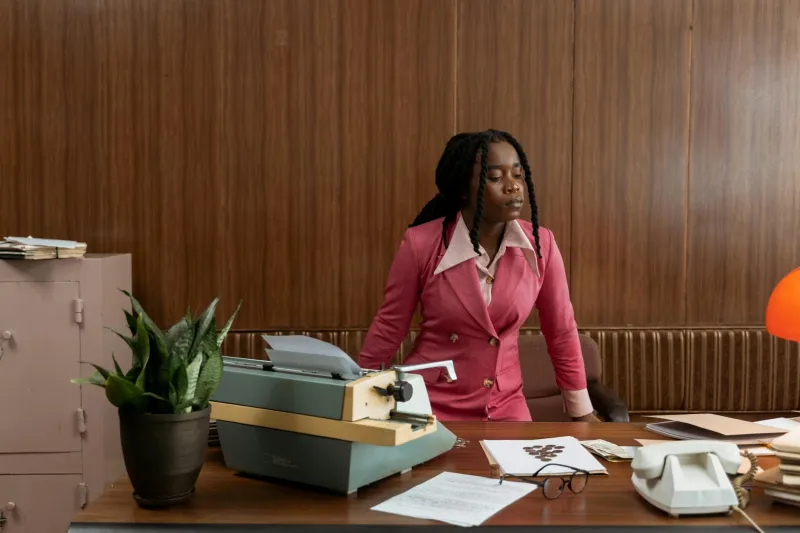
For most workers in 1960, the tools of the job were physical: typewriters, carbon paper, filing cabinets, adding machines, and the telephone. The idea that every desk worker would one day have a personal computer — let alone a device in their pocket more powerful than anything that existed in 1960 — was the stuff of speculative fiction.
The practical consequences of this are easy to underestimate. Tasks that today take minutes — pulling a report, searching a database, sending a document to a colleague across the country — required hours or days of manual effort. Information was stored in physical files. Errors in typed documents required retyping the entire page. The sheer volume of administrative labor that computers have eliminated is staggering.
The Distance We've Traveled
None of this is to suggest that today's workplace is without serious problems. Income inequality has widened. Job security has eroded. The gig economy has stripped benefits from millions of workers. The always-connected expectation of modern work has created new forms of stress that 1960s employees didn't carry home.
But the baseline — the floor of what a worker can expect in terms of physical safety, legal protection, and basic dignity — has risen substantially. The smoke-filled room is gone. The explicitly segregated job listings are gone. The complete absence of any legal protection against unsafe conditions is gone.
Two generations is a short time in historical terms. The distance between that world and this one is longer than it looks.