Fifty Thousand Products, One Roof: How the American Grocery Store Became a Portal to the Whole Planet
There's a jar of tahini in your refrigerator door. A bag of jasmine rice in the pantry. Maybe some gochujang, or a lime that came from Mexico, or a block of manchego that was made in Spain. None of this feels remarkable to you. You picked it up at the regular grocery store, probably without giving it much thought.
Your great-grandmother would have had absolutely no idea what any of it was.
The American grocery store has undergone one of the quietest and most dramatic transformations in the history of everyday life. It happened gradually enough that most people didn't notice. But the contrast between the supermarket of 1960 and the one you walked through this week is so vast it almost defies comparison.
The Store That Grandma Knew
The postwar American supermarket was, by modern standards, a fairly modest operation. Chains like A&P, Kroger, and Safeway dominated the landscape, and they stocked somewhere in the neighborhood of 4,000 products — a number that felt revolutionary at the time, given that it was already a massive improvement over the corner grocery store.
But look more closely at what those 4,000 products actually were. Canned vegetables. Domestic cuts of meat. White bread. American cheese. Iceberg lettuce. Ketchup. Canned fruit cocktail. Jell-O. The ethnic food aisle, if it existed at all, was likely a single shelf with a few Italian-American staples — canned tomatoes, maybe some pasta, a jar of oregano.
Olive oil, if you could find it at all, was stocked in the pharmacy section — sold not as a cooking ingredient but as a remedy for constipation and ear problems. Avocados were a curiosity found in specialty stores in California and Florida, largely unknown to most of the country. Garlic was considered aggressively ethnic. Yogurt was health-food-store territory. Soy sauce might appear in a small bottle, filed under "exotic."
The American diet of 1960 was, in global terms, extraordinarily narrow — and the grocery store reflected that faithfully.
What Cracked the Door Open
Several forces converged to change this, and they didn't arrive all at once.
The Immigration and Nationality Act of 1965 was arguably the single most important grocery-store legislation never written about groceries. By opening immigration from Asia, Latin America, and other regions that had been heavily restricted, it seeded American cities with communities that demanded — and eventually created — food businesses catering to their own tastes. Vietnamese grocery stores appeared in New Orleans. Indian spice shops opened in Chicago. Mexican markets spread across the Southwest and then kept going.
 Photo: New Orleans, via www.travelmag.com
American travelers played a role too. The jet age made international travel accessible to the middle class for the first time, and people came home from Europe or Asia having tasted things they couldn't stop thinking about. They wanted to recreate those flavors at home. They created demand.
Julia Child deserves her own paragraph. Her 1961 cookbook Mastering the Art of French Cooking and her subsequent television presence introduced millions of Americans to the idea that cooking with unfamiliar ingredients — shallots, crème fraîche, real butter — was not intimidating but joyful. She didn't just teach recipes. She taught curiosity.
 Photo: Julia Child, via cdn.britannica.com
And then the global supply chain quietly did the rest. Refrigerated shipping made it possible to move produce across continents without spoiling. Trade agreements opened markets. Agribusiness scaled up production of crops that had previously been regional specialties.
The Numbers Tell the Story
By 1980, the average American supermarket had expanded to roughly 15,000 products. By 2000, that number was approaching 30,000. Today, larger stores regularly stock 40,000 to 50,000 distinct items. The produce section alone at a well-stocked modern supermarket carries more variety than an entire 1960s store.
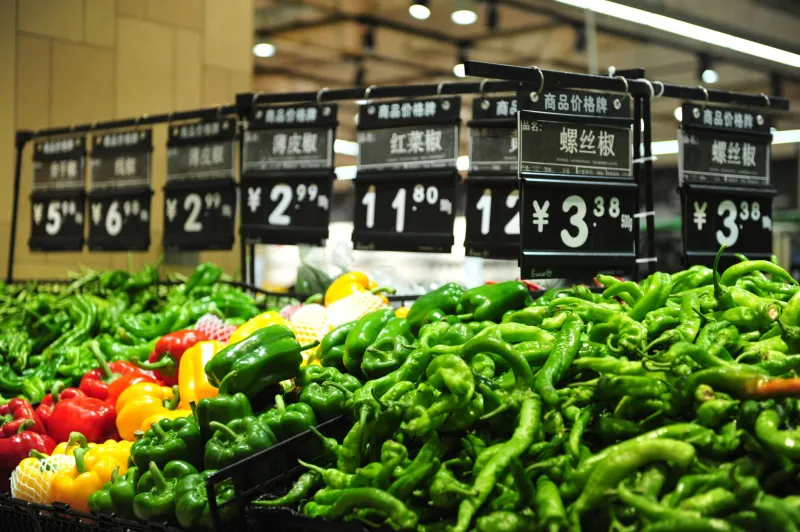
Consider what that produce section now contains: dragon fruit, jicama, lemongrass, bok choy, multiple varieties of mango, fresh turmeric, four kinds of kale, and at least six different peppers — none of which would have registered as a grocery item to the average American shopper sixty years ago.
The international aisle has, in many stores, essentially taken over. There are dedicated sections for Korean ingredients, Southeast Asian pantry staples, Latin American sauces, Middle Eastern dips, and European cheeses. What was once a single shelf is now a substantial portion of the store's real estate.
What Food Reveals About Identity
Food is never just food. What a culture eats is a map of who it's become, what influences it has absorbed, which communities it has welcomed, and how its sense of self has expanded or contracted.
The transformation of the American grocery store is, in this sense, a kind of unofficial immigration history — a record of every wave of newcomers who brought their ingredients with them and eventually persuaded their neighbors to try them. Hummus went from a Middle Eastern specialty food to a mainstream snack found in every gas station refrigerator case. Sriracha went from a niche condiment in Vietnamese-American communities to a flavor that appears on everything from potato chips to fast-food sandwiches.
None of this happened through a policy decision or a cultural mandate. It happened because people tried things and liked them. Appetite, it turns out, is a remarkably effective engine of cultural exchange.
A Different Kind of Abundance
There's a version of this story that's purely triumphant: Americans eat better, more diversely, and with more awareness of the world than at any point in history. That's largely true.
But it's also worth noting what got lost. The local, seasonal rhythms that once governed what appeared in the produce section have been largely overridden by global supply chains that make strawberries available in January and asparagus available in December. The neighborhood butcher who knew how every cut was sourced has been replaced by shrink-wrapped packages with minimal information.
The store got bigger. The world got smaller. And somewhere between the tahini and the gochujang, the American grocery cart became something your great-grandmother genuinely couldn't have imagined — a small, weekly act of global citizenship.