How Americans Stopped Spending Half Their Lives Paying for Food
How Americans Stopped Spending Half Their Lives Paying for Food
Here's a number worth sitting with: in the early 1900s, the average American household spent somewhere between 40 and 50 percent of its income on food. Nearly half of everything a family earned went toward keeping itself fed.
Today, according to USDA data, Americans spend about 11 percent of their disposable income on food — and that includes both groceries and restaurant meals. If you're only counting what people cook at home, it's closer to 8 percent.
That shift — from nearly half your paycheck to roughly one-tenth of it — is one of the most dramatic economic transformations in American history. It happened gradually, across a century, and most people walking through a supermarket today have no real sense of just how different things used to be.
When Feeding Your Family Was a Full-Time Financial Concern
To understand what food costs meant in the early 20th century, you have to understand how food was produced. In 1900, roughly 40 percent of the American workforce was employed in agriculture. Growing, harvesting, and transporting food was enormously labor-intensive, and labor costs drove prices up.
Families in industrial cities — the working-class immigrants and factory laborers who made up a huge portion of the urban population — spent the majority of their earnings on the basics: bread, potatoes, beans, and whatever meat they could afford. Processed or packaged food barely existed. Everything was bought fresh, often daily, because home refrigeration was not yet widespread. Buying in bulk wasn't really an option when you had no way to keep things cold.
For rural families, the equation was different but not necessarily easier. Many grew their own food, which reduced cash spending but replaced it with an enormous investment of time and labor. Either way, food dominated family economics in a way that's genuinely hard to imagine today.
The Machinery That Changed Everything
The transformation started in the early 20th century and accelerated dramatically after World War II. Several forces hit at roughly the same time, and their combined effect was staggering.
Mechanized farming was the foundation. The replacement of horse-drawn plows with gasoline-powered tractors, and eventually with massive combine harvesters and automated irrigation systems, allowed a single farmer to work land that would have required dozens of laborers a generation earlier. Between 1900 and 1970, farm output per worker roughly quadrupled. Food got cheaper because producing it got cheaper.
Refrigeration was the other game-changer. Home refrigerators became widely affordable in the 1930s and 1940s, and commercial cold-chain logistics — the network of refrigerated trucks, warehouses, and shipping containers that moves perishable food across the country — expanded dramatically through the mid-century. This meant food could be produced in bulk, stored, and transported over long distances without spoiling. The economics of scale that refrigeration enabled pushed prices down further.
The rise of global supply chains finished the job. Today, the strawberries in your grocery store in January might have been grown in Mexico, the salmon flown in from Chile, and the olive oil pressed in Spain. American consumers have access to a year-round abundance of food from every corner of the world, and global competition keeps prices low.
A Supermarket Miracle — With an Asterisk
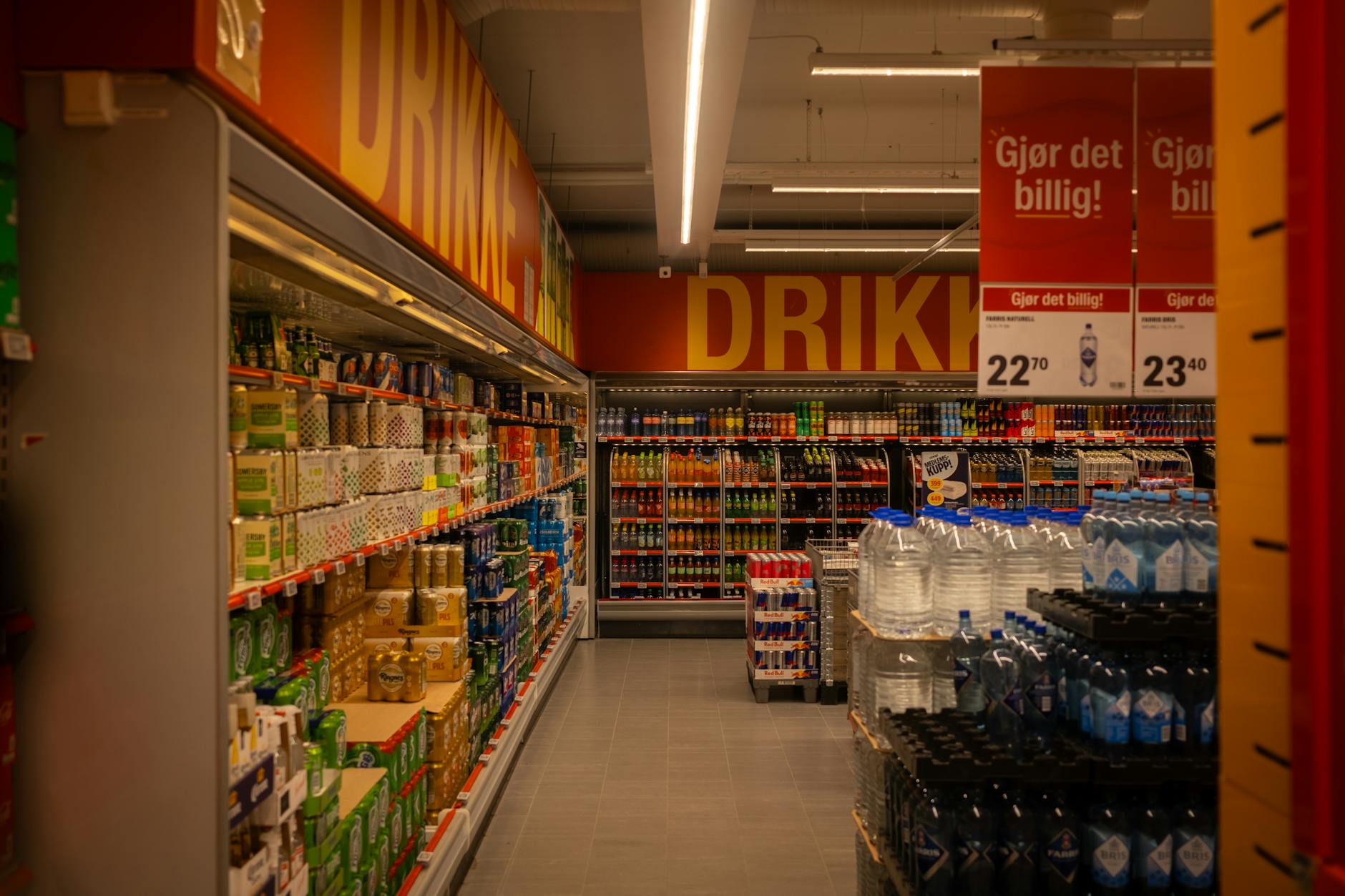
Walk into a modern American supermarket and the scale of this transformation is almost overwhelming. Thousands of products, available year-round, at prices that would have seemed like science fiction to someone shopping in 1930. A pound of chicken breast that costs $3 today would have represented several hours of work for a factory laborer a century ago.
By any straightforward economic measure, this is an extraordinary achievement. Cheap food has freed up enormous amounts of household income that Americans now spend on housing, healthcare, education, and entertainment. It has essentially eliminated the kind of subsistence-level food insecurity that was routine for working-class families a century ago.
But — and this is a significant but — the full ledger of cheap food is more complicated.
What We Traded Away
The industrialization of the American food supply didn't just make food cheaper. It fundamentally changed what food is.
The rise of processed and ultra-processed food is inseparable from the cheap food story. Shelf-stable, mass-produced products — packaged snacks, frozen meals, fast food — became cheap partly because they're engineered to be cheap. Refined grains, added sugars, industrial seed oils, and preservatives replaced more expensive whole ingredients. The result was food that was affordable and calorie-dense but often nutritionally hollow.
The data on this isn't subtle. Rates of obesity, type 2 diabetes, and diet-related chronic disease have climbed steadily over the same decades that food spending as a share of income has fallen. The connection isn't one-to-one — lots of factors are at play — but researchers have documented a clear relationship between the availability of cheap, ultra-processed food and deteriorating nutritional outcomes, particularly in lower-income communities.
There are environmental costs, too. Industrial-scale agriculture is a significant contributor to greenhouse gas emissions, water use, and soil degradation. The cheap price on a supermarket shelf doesn't include the long-term environmental bill.
And then there's the human side of the supply chain. The low cost of food in America is partly subsidized by low wages — in the fields, in the processing plants, and in the restaurants where an increasing share of American food dollars are spent.
The Price of Cheap
None of this is to say the progress isn't real. Spending 11 percent of your income on food instead of 40 percent is an enormous improvement in material living standards, and the reduction in genuine food hardship over the past century is worth acknowledging clearly.
But cheap food, like most things that seem straightforwardly good, comes with a set of trade-offs that aren't always visible at the checkout counter. The question isn't really whether the transformation was worth it — in many ways, it clearly was. The question is whether we're honest about everything that went into the price tag.
Your grocery bill is lower than your great-grandparents' ever was. The reasons for that are genuinely impressive. The full story of how it happened is more interesting — and more complicated — than the number alone suggests.