When Summer Was the Enemy: Life in America Before Air Conditioning
When Summer Was the Enemy: Life in America Before Air Conditioning
Today, complaining about summer heat usually means grumbling while walking from an air-conditioned car to an air-conditioned office. A minor inconvenience. A few sweaty seconds. But step back just a few generations, and the picture looks almost unrecognizable. For most of American history, summer wasn't a season to enjoy — it was something to endure, outsmart, or escape altogether.
The invention that quietly restructured American life didn't come with much fanfare. But make no mistake: air conditioning didn't just cool buildings. It rewired the entire country.
The Heat Was Actually Deadly
Before we romanticize the past, it's worth being blunt about what extreme summer heat meant in practice. It killed people — regularly and in large numbers. The New York City heat wave of 1896 killed an estimated 1,500 people in a single week. Chicago's 1901 heat disaster claimed over 600 lives. These weren't freak events. They were the predictable, recurring cost of summer in an era without climate control.
Heat-related illness was a constant threat, particularly for the urban poor, factory workers, and infants. Babies were especially vulnerable, and summer spikes in infant mortality were so reliable that they were simply accepted as a grim seasonal reality. Newspapers ran daily "heat death" tallies the way they now track weather forecasts.
For the working class, there was no relief. You worked, you sweated, and you hoped you didn't collapse.
The Ingenious (and Exhausting) Ways People Coped
Americans didn't just suffer passively. They adapted — and some of those adaptations were surprisingly creative.
Rooftop sleeping became common in crowded cities. On hot nights, families in tenement neighborhoods would haul their bedding up to fire escapes and rooftops to catch whatever breeze existed above street level. In cities like New York, this was so widespread that newspapers reported on it matter-of-factly. It was simply what you did.
Ice delivery was a genuine industry. Before mechanical refrigeration, ice was cut from frozen northern lakes during winter, packed in sawdust, and shipped to cities for summer use. Families relied on icebox deliveries to keep food from spoiling and to cool drinks. The iceman wasn't a quaint historical figure — he was essential infrastructure. When ice supplies ran short during heat waves, it made front-page news.
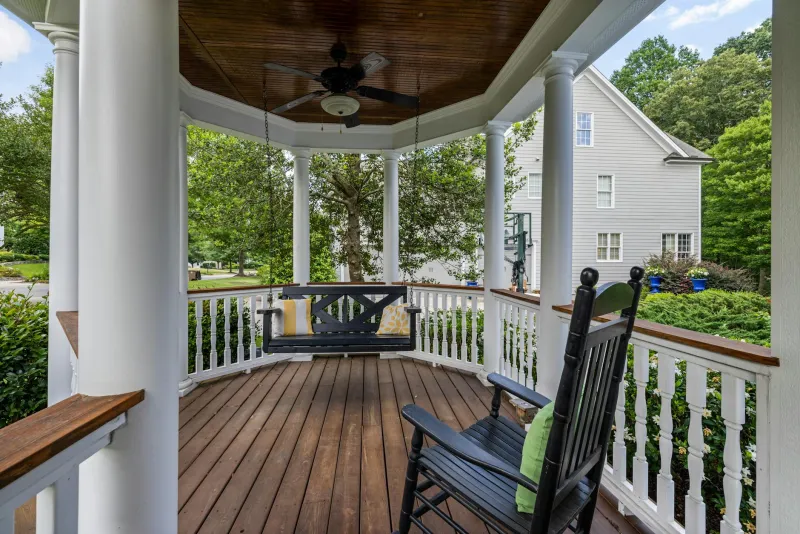
Architecture itself was designed around heat survival. Houses were built with high ceilings to let hot air rise away from living spaces. Deep porches provided shade. Thick walls slowed heat absorption. Cross-ventilation was engineered into floor plans. Sleeping porches — screened outdoor rooms specifically designed for overnight use in summer — were a standard feature of middle-class homes across the South and Midwest. These weren't luxury additions. They were necessities.
Entire cities emptied out. Wealthy Americans practiced what historians call "summer migration" — leaving sweltering urban centers for coastal or mountain retreats from June through September. Newport, Rhode Island, the Catskills, and Cape Cod weren't just vacation spots; they were functional escapes from genuinely dangerous conditions. For those who couldn't afford to leave, survival meant staying close to parks, rivers, and any open water available.
The Invention That Changed Everything
Willis Carrier developed the first modern air conditioning system in 1902, but it took decades for the technology to reach ordinary Americans. Early systems were industrial — installed in factories, print shops, and eventually movie theaters. The fact that cinemas were air-conditioned before most homes were is part of why summer moviegoing became such a cultural institution. People weren't just going to see films. They were paying for two hours of cool air.
Window unit air conditioners began appearing in American homes in the late 1940s and through the 1950s, but adoption was slow and uneven. As late as 1960, fewer than 20 percent of American homes had any form of air conditioning. By 1980, that number had climbed above 55 percent. Today it sits above 90 percent.
The shift happened fast in historical terms — and the consequences were enormous.
How AC Remapped America
Here's something worth sitting with: the Sun Belt as we know it — Phoenix, Houston, Miami, Las Vegas, Atlanta — would not exist at its current scale without air conditioning. These cities didn't just grow because of AC; they became livable year-round because of it. Phoenix reached a high temperature of 118°F in June 2021. Without climate control, sustained urban life there would be essentially impossible for much of the population.
Before widespread air conditioning, the American South was economically and demographically stagnant partly because summer conditions made sustained productivity so difficult. The post-WWII economic rise of the Sun Belt tracks almost precisely with the spread of residential air conditioning. Businesses relocated. Retirees followed the warmth without fearing it. Population shifted south and west at a pace that reshaped national politics, culture, and infrastructure.
Sleep itself changed. The average American no longer plans their night around heat management. Rooftop sleeping vanished. Sleeping porches became storage rooms or were simply removed during renovations. The entire architecture of heat survival was quietly retired.
What We Forgot to Appreciate
It's easy to take a climate-controlled bedroom for granted when you've never known anything else. But consider what was lost in exchange for what was gained: the communal culture of front porches and shared public spaces, where neighbors gathered out of necessity, has largely faded. The rooftop sleepers of 1900s New York were miserable — but they were also together.
And of course, the energy cost is real. Air conditioning accounts for roughly 6 percent of all electricity produced in the United States annually, at a cost of about $29 billion. The environmental footprint of keeping 330 million people cool is staggering.
None of that changes the math on what was gained. Thousands of Americans who would have died in summer heat waves simply don't. Cities that would have been uninhabitable are thriving. Sleep, productivity, and quality of life improved across the board.
Summer used to be something Americans survived. Now it's something they schedule vacations around. That's not a small change — that's a complete reinvention of how an entire season fits into a life.